
Understanding Electromagnetic Spectrum
Before delving into Hyperspectral Imaging, it is crucial to explore the electromagnetic spectrum, a comprehensive scale encompassing various types of light, ranging from radio waves to X-rays, much of which is imperceptible to the human eye. Picture it as an extended rainbow with a multitude of colors. This spectrum serves as the foundation for hyperspectral imaging’s ability to perceive intricate details.
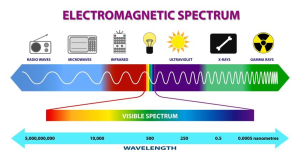
While conventional cameras utilize three colors (red, green, and blue) for image capture, hyperspectral cameras employ a more extensive range of colors, spanning from 250 nm to 15,000 nm and even including infrared, which detects heat. This broad spectrum enables a profound understanding of the interaction between light and objects, a field known as spectroscopy.
Spectral imaging systems, functioning as specialized cameras, have the capacity to capture and interpret diverse types of light, extending beyond the visible spectrum. They transform this light information into vibrant images that provide insights into the composition and behavior of the depicted subjects, going beyond the capabilities of traditional cameras.
How does hyperspectral imaging work?
The Hyperspectral Camera operates by simultaneously capturing images and collecting detailed color information within those images. It meticulously records the colors of every individual pixel in the photo, generating a unique set of spectrum data for each dot. The amalgamation of these distinct colors results in what is known as a hyperspectral image. Like the uniqueness of each person’s fingerprint, different materials and objects leave behind distinctive “fingerprints” in terms of color spectra. Consequently, by analyzing the colors present in each pixel, we can discern and quantify the composition of the depicted subjects in the image.
What information hyperspectral imagine provide?
The information provided by the Hyperspectral Camera is twofold, offering insights into both the chemical properties of objects and their spatial coordinates. It functions as a virtual detective, answering questions about “what” something is based on its colors, “where” it is located, and even “when” the information was captured.
For instance, let’s take a chili dataset captured with the Specim IQ Hyperspectral Camera.
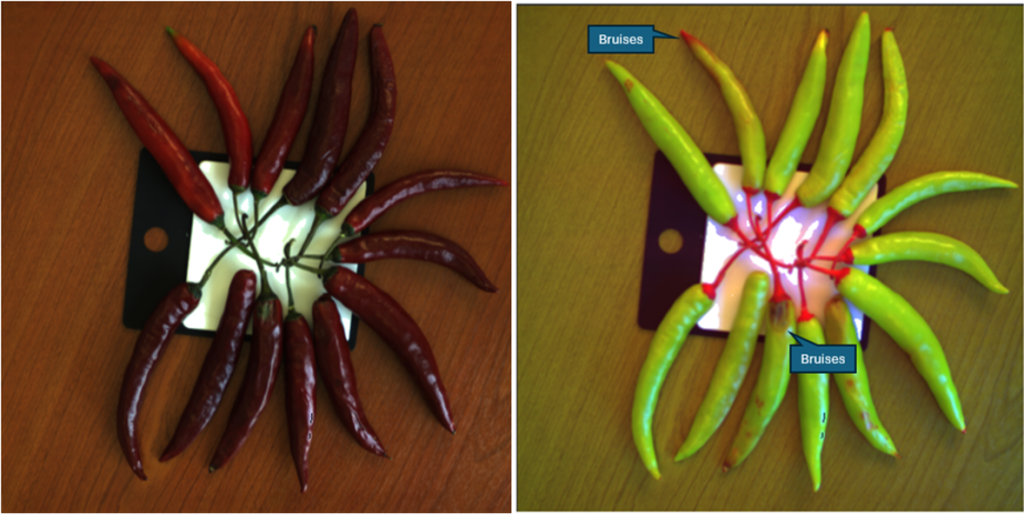
Chilli Under Normal RGB Camera Chilli Under Hyperspectral Camera wih IR range
In comparison to conventional RGB cameras, the hyperspectral camera reveals the chili’s appearance in the infrared (IR) range, providing a wealth of additional information. This is akin to using a super microscope; hyperspectral imaging offers a broader range of colors and perspectives, facilitating a more precise analysis. It allows us to distinguish between materials that may appear similar and even detect phenomena that are invisible to the naked eye, such as bruising on plants. In essence, hyperspectral imaging serves as a powerful tool, enhancing our ability to analyze and understand the intricacies of the world around us.
Hyperspectral Imaging Applications
Hyperspectral imaging is gaining widespread popularity for its exceptional versatility across diverse domains, spanning industries, research, and remote inspections. What distinguishes it is its capacity to unveil details that go beyond the capabilities of regular cameras and the human eye. In industrial settings, hyperspectral imaging proves to be invaluable for inspecting products, identifying foreign objects, and evaluating attributes such as fat content— all achieved without causing any damage. Effectively acting as a super eye, it enables the detection of details imperceptible to the naked eye, revolutionizing the way we scrutinize and comprehend our surroundings. Here are some additional fascinating applications:
- Environmental Monitoring: Observing changes in land, plants, and water over time to detect potential issues early on.
- Mineral Exploration: Identifying minerals in the ground and determining their composition.
- Quality Control: Ensuring the quality of food and other products without the need for breakage or damage.
- Waste Management: Improving the sorting of different materials in recycling processes.
- Agriculture: Overhead inspection of crops to assess their health and identify any necessary interventions.
Do you want to learn more about HSI and find the right hyperspectral cameras and solutions for your applications or project? Our specialists are here to provide a free consultation. Connect with us now.