
What is gloss?
Gloss is the attribute of surfaces that causes them to have a shiny or lustrous appearance. It is generally associated with specular reflection by surfaces of object. However, specular reflection can vary from one surface to another. There are as follows:
- The fraction of light reflected in the specular direction
- The manner and extent to which light is spread to either side of this specular direction
- The change of specular reflection factor as specular angle changes
Gloss measurement is based on the amount of light reflected on the surface relative to a polished glass reference standard. The amount of light that is reflected on the surface is dependent on the angle of incidence and the properties of the surface. The unit measurement of gloss is Gloss Unit (in short is GU). The lower the GU the less gloss reflection. Whereas the higher the GU the more gloss reflection.
There are several different geometries available for gloss measurement. Each being dependent on the type of surface to me. A non-metal such as coatings and plastics, the amount of reflected light increases with an increase in the angle of illumination as part of the light penetrates the surface material and part is absorbed into it or diffusely scattered and is depending on its color. Metal has much higher reflection and are therefore less angular dependent.
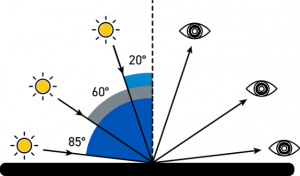
Gloss is categorized as either matt, semi, high gloss finishes. Measurement angle refers to the angle between the incident and reflected light. Three measurement angles (20º/60º/85º) are specified to cover the majority of industrial coating applications. To determine or select the appropriate angle to meet your application, the angle is selected on the anticipated gloss range using a glossmeter measurement angle of 60º.
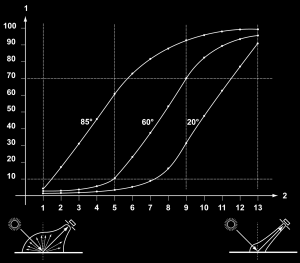
All gloss gloss level can be measured using a 60º measurement angle glossmeter. 60º angle is used as the reference angle with the complimentary angles of 85º and 20º often used for matt (low) and high gloss levels respectively.
To select the appropriate angle for gloss measurement, here are the rule of thumbs that help to determine the correct gloss angle to use.
- 20° geometry – High Gloss. Gloss Measurement at 60° is above 70GU
- 60° geometry – Semi/Medium Gloss. Lies in between 10 and 70GU
- 85° geometry – Matt Gloss. Gloss Measurement at 60° is below 10GU
Rhopoint offers a comprehensive range of single, dual and three angle glossmeter as well as an advanced model that measure not only gloss but also DOI, Haze, Image Quality that can be apply on a wide range of surfaces. Standard gloss meter is not able to fully characterize the appearance of the finish products.