
CCD ARRAY SPECTROMETER CAS 120
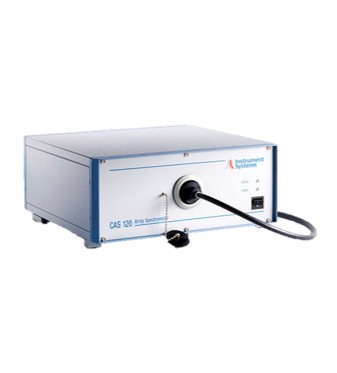
A Poweful Spectrometer Designed Specifically For Production and Labortory Used
Instrument Systems CCD Array Spectrometer CAS 120 deploy the proven metrology from Instrument Systems even in price sensitive applications, such as LED production testing or quality assurance. CAS 120 spectrometer presents an appealing solution for cost-sensitive applications like LED production and quality assurance. Although costs have been reduced, technical innovations deliver even higher levels of reliability and robustness. The CAS 120 complies with the high requirements for measuring accuracy and versatile application without any compromises.
Unique technical innovations integrated in the CAS 120 result in a higher level of dependability and speed. These benefits are achieved alongside reduced cost even under the demanding conditions experienced in 24/7 production environments. The spectrometer also complies with the exacting requirements of accuracy and versatility without compromise.
A back-illuminated CCD area sensor with 2048 x 14 pixels is used for all models. Vertical binning enhances the dynamic range. Cost-intensive cooling of the CCD detector has been deliberately omitted for the CAS 120. Instead, the temperature of the CCD sensor is recorded each time a spectrum is measured, and the signal is then corrected.
APPLICATIONS
Industrial Quality Control | Production Testing | Laboratory | VIS And UV VIS Range
CAS 120 CCD Array Spectrometer
- Model versions UV/VIS and VIS
- Precision spectrograph with integrated density filter wheel (OD 1 – 4)
- Shutter for automatic dark current correction
- 2048 x 14 pixels back-illuminated CCD detector, 16 bit ADC
- Short integration times of 4 ms
- USB interface
- Hardware I/O trigger
CAS 120 CCD Array Spectrometer
| Model | CAS120-152 (UV/VIS) | CAS120 151 (VIS) |
| Spectral Range | 200 ~ 800 nm | 360 – 830 nm |
| Detector | Back-thinned CCD | Back-thinned CCD |
| Number of pixels | 2048 x 14 | 2048 x 14 |
| Spectral resolution¹⁾ | 2.7 nm | 2.2 nm |
| Data Point Interval | 0.35 nm | 0.3 nm |
| Wavelength Accuracy²⁾ | ± 0.3nm | ± 0.3nm |
| Integration time | 4 msec ~ 20 sec | 4 msec ~ 20 sec |
| Linearity | ± 0.6% | ± 0.6% |
| Straylight | ||
| Broadband fo Illumination A radiation³⁾ | 7 x 10̄ ⁴ | 5 x 10̄ ̄⁴ |
| for LED⁴⁾ | 5 x 10̄ ̄⁴ | 5 x 10̄ ̄⁴ |
| with laser⁴⁾ | 1 x 10̄ ̄⁴ | 1 x 10̄ ̄⁴ |
| LED measurement | ||
| Measuring range luminous intensity⁵⁾ | 1 mcd ~ 5 kcd | 2 mcd ~ 5 kcd |
| Measuring range luminous flux⁶⁾ | 1 mlm ~ 3.3 klm | 2 mlm ~ 3.3 klm |
| Measuring uncertainty luminous intensity⁷⁾ | ±4% | ±4% |
| Measuring uncertainty luminous flux⁷⁾ | ±4% | ±4% |
| Measuring uncertainty dominant wavelength⁷⁾ | ±0.5nm | ±0.5nm |
| Measuring uncertainty color coordinated⁷⁾ | ±0.002 | ±0.002 |
| Spectroradiometry | ||
| Sensitivity range for iirradiance⁸⁾ | 5 x 10̄ ̄⁸ – 5 x 10² W/m²nm | 3 x 10̄ ̄⁸ – 3 x 10² W/m²nm |
| Signal sensitivity at 1s integration time⁸⁾ | 8 x 10̄ ̄⁷ W/m²nm | 5 x 10̄ ̄⁷ W/m²nm |
| Spectrradiometric accuracy⁷⁾ | ±4% | ±4% |
| Measurement accuracy for color coordinates at illuminant A⁷⁾ | ±0.002 | ±0.002 |
| Reproducibility of color coordinate measurement at illuminant A⁷⁾ | ±0.0002 | ±0.0002 |
| Spectrophotometry | ||
| Baseline noise⁹⁾ | ±400 counts or ±2.5% | |
| Photometric transmission measurement accuracy | ±1% T | |
| Baseline drift¹⁰⁾ | 0.3%/h | |
| Spectrograph | ||
| Focal length, f number, grating | approx 120mm, f/3.5, plane refrection grating | |
| Slit | Models UV/VIS and VIS : standard: 100 μm; optional: 50 μm | |
| Filter wheel / Shutter | Standard for all models; density flter OD 1 – 4; model UV/VIS with UV density flters; position monitoring with encoder | |
| Electrical Data | ||
| AD converter | 16 bit resolution | |
| PC interface | USB 2.0 | |
| Triggering | Input: TLL ascending slope; output: 2 TTL outputs (software controlled), one TTL fash pulse | |
| Miscellaneous | ||
| Dimension (H x W x D mm) | 147 x 343 x 317 mm | |
| Power supply | Wide-range input 100 VAC to 240 VAC 50/60 Hz | |
| Power consumption | max. 35 VA | |
| Ambient temperature | 15 – 35 °C; relative humidity 70 % max., non-condensing | |
| Weight | approx. 7 kg | |
| Standards complaince | In conformity with EN 61010-1:2002-08 (safety requirements governing electrical equipment for measurement, control and laboratory use) | |
1) Approximate values for 100 μm standard slit. Other values for optional 50 μm slit.
2) Applies to Penray lamp or laser.
3) Measured at 400 nm in combination with a GG455 long-pass filter relative to peak intensity of unweighted spectral data.
4) Measured at 150 nm gap left of the peak wavelength, relative to peak intensity of unweighted spectral data.
5) Applies for a signal/noise ratio of 10:1, for yellow LED with 585 nm and with LED-436 Adapter. The values are a factor of 20 to 100 higher for white LEDs.
6) Applies for a signal/noise ratio of 10:1, for yellow LED with 585 nm and with ISP250 Integrating Sphere. The values are a factor of 20 to 100 higher for white LEDs.
7) Immediately after calibration relative to the calibration standard and without density filter. Indicated errors refer to the twofold standard deviation.
8) Measured with EOP-120 External Optical Probe and OFG-414 Fiber Bundle, at 600 nm wavelength and signal/noise ratio of 10:1, including the density filters and without averaging.
9) Signal level for shortest integration time and at 30,000 counts.
10) Applies for 30 minutes with LS100-130 after 1 hour warm-up time.